From Christ to Obedience

jasmin-ne--95puUbV4Bg-unsplash.jpg

by Jason Park

As the youth group is coming to an end in our series in 1 John, I thought it would be helpful to unpack the heart of John’s message in this letter. 

The letter has traditionally been explained as a series of tests to determine if you’re saved or not. While this view is true to an extent, it doesn’t line up with the actual contents of the letter. We get a better grasp of John’s intent when we look at the beginning and end of the letter. 

1:1-3 is about John’s firsthand interaction with the incarnate Christ. 5:18-20 is about three gospel-facts that believers know. 1:4 ends with John stating that he’s writing the letter so that our joy may be made complete. 5:13, the purpose statement of the whole letter, syncs up with 1:4 by stating that the letter is written so that believers may know that they have eternal life. 

In between, John unfolds Christ: His nature, His work on the cross, and their implications for our lives. There are only thirteen imperatives in the letter. Most of the commanding occur implicitly (e.g., 3:3 - “And everyone who has this hope purifies himself, just as He is pure”). 

That approach fits with the overall focus of the letter on the person and work of Christ. Certainly, if you fail to believe truths about Christ or you don’t love believers at all, you’re not a believer. But John’s push is for us to grasp the grandeur of Christ the God-Man and His propitiating, love-sacrifice for our sins (1:7; 2:1-2; 3:5, 16; 4:2, 9-10; 5:5-8).  Because when we grasp these truths, we will abide in Christ and love one another for a lifetime. 

So, we need to “let that [the gospel] abide in you which you heard from the beginning” (2:24). When that occurs, we abide in the Son and in the Father (2:25) – we have fellowship with the Godhead, which is what we were made to experience (1:3). And when we abide in Christ, we will practice righteousness (2:28-29). 

Obedience is not burdensome; it’s liberating; it’s joyful. Because we want to give ourselves to the One who gave Himself to us. Think of it - the true God and eternal life (5:20) died for my sins. How can I not do whatever He asks of me? 

The Spirit’s Work - Part 3: Revealing Jesus

kyle-johnson-CT8NvobyYuk-unsplash.jpg

by Jon Buck

“Now the Lord is the Spirit, and where the Spirit of the Lord is, there is liberty. And we all, with unveiled face, beholding as in a mirror the glory of the Lord, are being transformed into the same image from glory to glory, just as from the Lord, the Spirit.” 
~ 2 Cor. 3:17-18

We’ve seen that the Holy Spirit works to remind us that we are children of God, and that we have been united into a family. 

Paul, however, adds some additional clarity to what that activity looks like on an experiential level in 2 Corinthians 3:18. 

Beholding
Paul tells us that ‘we all’—that is, all believers—are beholding the glory of the Lord. This glory is ‘seen’ in Paul’s words, but that ‘seeing’ is in the heart, with spiritual eyes. 

Later, in 4:4, we find out that the light of the glory of the Lord that we are seeing in our hearts is the Gospel. That is, that in believing the good news of the death and resurrection of Jesus Christ for our sins, we ‘see’ this glory in our hearts. 

The reality of the Gospel—that is, that the Lord Jesus Christ loved us and gave Himself up for us—is the place where we see God’s glory in our hearts. This happens for us individually and personally. Just as Moses saw God’s glory in the wilderness, we can see His glory as well. Ours, though, happens spiritually rather than physically. 

Freedom to see
In Exodus 34:34, Moses’ practice of placing a veil over his face is explained. When he would go in to meet with YHWH, he would remove his veil. When he would go back out among the people, he would veil his face, because it glowed. 

Paul takes this imagery in 2 Cor. 3:17 and explains that the Lord, YHWH, is the Spirit. The Spirit works to offer freedom (liberty in the NASB). 

But from what does the Spirit offer us freedom? The answer is connected with the veil. The heart of unbelievers is hard—it doesn’t want to see God because it is enslaved to sin. 

The Holy Spirit removes the veil of hardhearted unbelief, and reveals the glory of Jesus in His Gospel love for His people, seen most clearly at the cross. 

What does it mean for us? It means that we have unrestricted access, through the Holy Spirit, to see and enjoy the beauty and glory of Jesus (Heb. 4:14-16). 

You, Christian, are free to enter into His presence at any time! You can see Him. You can behold His glory. You can be filled with JOY in knowing He loves you. 

Why? Because the Spirit has set you free to see Jesus by faith in the Gospel!

The Power in Prayer

pedro-lima-HtwsbbClBOs-unsplash.jpg

by Jason Park

Upon calling the Colossian saints to be devoted to prayer with alertness and thanksgiving in Col 4:2, Paul asks that this church pray for his missionary team in Col 4:3-4. 

This seems basic enough. But step back and realize what’s going on in this request. 

The apostle Paul is asking for a regular church to pray that God will open up a door for him to preach the gospel with clarity. 

The writer of 13 inspired letters… …the one uniquely tasked by God to preach the gospel to the Gentiles…the theologian whose works form the basis of our theology…this man asks a church to pray for the very endeavor he was called by God to fulfill.  

You would think Paul had everything he needed to fulfill his mission. And he did, but not in a self-reliant sense. He understood the magnitude of his apostolic work. So, he acutely felt the need to enlist more aid. And the best aid of all was (and continues to be) prayer

Though he was called to go to the Gentiles with the gospel, Paul needed prayer for God to open doors for evangelism. Though he was taught the mysteries of Christ by Christ Himself, he needed clarity from heaven to speak the gospel rightly. You could say Paul needed God more than anyone else. 

We give him to much credit if we elevate the man and forget the massive power behind him: the power of God. Every aspect of his ministry was dependent on God. And being imprisoned for the gospel drove that sense of dependence like a nail deeper into his heart. 

How much more do we need to realize our dependence on God! We cannot open a door, have a clear gospel-thought, or boldly speak forth Christ apart from God’s power. We are at the mercy of His sovereign grace not only for ministry, but for all things. And yet, what a wonderful position to be in! Embracing that position brought much fruit to Paul’s life. It will bring much fruit to ours. 

Now more than ever, we all have an open door…to pray boldly for God to work in and through us in these unprecedented times so that people would see their need for Christ. As we are called to represent our Master, we are commanded to pray so that our Master’s power would flow down into us so that we can carry out this call in a worthy manner. 

He is our power in prayer. So, let’s draw on Him and wait for Him to act. 

The Spirit’s Work - Part 2

caleb-gregory-kGa56RzfbIM-unsplash.jpg

by Jon Buck

In the last post we saw that the Holy Spirit works in our hearts to communicate to us that we are the children of God. This activity by the Spirit in the heart of a true Christian is called a ‘testimony’, and points us to God as our Father. 

As we believe this reality, our hearts are ‘walking in’ the Spirit, and we generate the fruits of the Spirit (Gal. 5:22-23). 

But the Spirit also does many other things as a byproduct of this reality. 

Unity in the Spirit 
The Spirit of God gives the church unity. Paul encourages the believers in Ephesus to maintain the unity of the Spirit (Eph. 4:3). The implication, of course, is that the Spirit in each believer creates unity between the members of the body. 

This unity is familial—brothers and sisters in Christ are united together into a single family of God as they are adopted by Him through the blood of Christ. 

And this unity that the Spirit creates is threatened by sinful actions, but most especially by a lack of love. 

In a parallel text (Col. 3:14), Paul says that the perfect bond of unity is love. This should not be surprising, since love is the first fruit of the Spirit. 

Love in the family
But this all begs the question - where does love come from in order that the members of the family love each other? 

The answer throughout scripture is that love comes from God! 

1 John 4:10 makes it explicit that God loves us, and that is the ‘power generator’ for our love for Him and for others. 

And so, the Spirit’s work in telling us we are sons of God does not stop there! He unites us into a family, reveals the love of God to us, produces a love for God and a love for others in us, and unites us together in that love! 

The Need to Pray

ben-white-yy3GonY48N0-unsplash.jpg

by Jason Park

Is this what your prayer life looks like?

1.     Just do it.
2.     Keep it up for a week.
3.     Fail to pray as you ought to.
4.     Confess your failure.
5.     Get back at praying.
6.     Rinse…Repeat. 

Certainly, this process is a caricature. But caricatures work because they resemble the real thing.  

So, here’s my question: is this what our prayer lives look like? Or worse yet, do we have prayer in our lives? And whatever our answers may be to these questions…Why? 

Here are some common answers to the “why” question:
It doesn’t work.
I don’t think God listens to me.
God has never really answered any of my prayers.
I don’t know what to say to God.
I don’t know how to pray. 
I just don’t feel like praying.
 

This post can’t address all these answers, but it’ll attempt to address the heart behind devoted prayer – which is what the NT models and exhorts (Col 4:2). 

Most of us probably struggle at one time or another with the bare fact of praying at all or at least giving adequate time to it. The pressures of life squeeze out Bible reading and prayer. And in the rush to get things done, prayer gets dropped. But if you knew that you were going to die tomorrow and your doctor gave you a pill guaranteed to save you, would you take it? Of course you would!  

That’s how we should view prayer. It is our lifeline because it plugs us into the source of all life, love, and light – to God Himself. We are to pray without ceasing not merely out of duty, though it is that, but out of desperation, because we are walking buckets of need. It’s hard to see that reality, let alone admit it because our money, our success, our comforts, and our general well-being falsely masks our real condition: we’re needy children.  

If having the Spirit of Christ, the Bible, and the church were enough, why is prayer commanded? It’s commanded because that’s what God uses to work in and work out everything else that we’re called to be and do. Prayer works in that tension between our position in Christ and our progress in Christ. 

Prayer is what drives Scripture into our hearts so that we don’t sin and love righteousness. Prayer makes truth come alive to our souls so that we savor Christ more and not the idols of this world. Through prayer, God grants more of His Spirit, deliverance from sin, open doors for evangelism, our daily sustenance, a greater heart-sense of His love for us, and so much more. And corporately, prayer is what binds the church together because you can’t pray for someone regularly that you don’t love.  

Prayer is necessary. But when we realize how much blessing it yields, then our duty turns into delight because we see another dimension of prayer: it’s an open invitation from our loving Father to ask Him to do for us what we cannot do…to do for us all He’s promised in His binding Word.   

On May the Fourth, We Ask, “Why Star Wars?”

star+wars.jpg

by Jon Buck

George Lucas’ 1977 film Star Wars: A New Hope began a 4-decade-long empire that has spun off a plethora of side hits. These include a host of movies, cartoons, Disney theme parks, hundreds of action figures, among countless others. Lucas Films, George’s production house, sold for $4.05 billion in 2012, largely as a result of the success of the movies. 

But the question that we want to consider, particularly on May the Fourth (…be with you…) is why these movies have had such a massive following for so many generations. And, let me just say, with the exception of Jar Jar Binks, I personally enjoy the Star Wars films, so this question is something of a personal evaluation. 

Good and Evil
Perhaps more than any other film series, Star Wars portrays the great battle between good and evil in a powerful way. The films trace a single family, from Anakin Skywalker (Darth Vader) through his children, and their children, to a final character, Rey. Throughout these generations, the fight between good and evil rages, as empires rise and fall and characters wrestle with personal weakness. 

The wars that are waging around the characters also wage within them. The personal struggles of Anakin, Luke, Ben, and Rey all reflect the struggles of the human heart against evil. And the ultimate redemption of each of these characters reveals the triumph of good over evil. 

Humanity, while fully aware of evil in the world, still retains a conscious awareness of God, and the appeal of goodness. To see good triumph over evil through weak characters is a gripping narrative to the human soul, fraught with its own weaknesses. No wonder, then, that these stories of triumph have been box office successes. 

The ‘Force’
But perhaps the most gripping part of the movie series, and the basis for the fan following, is the Force. While mostly used to levitate rocks, this impersonal existence in all life becomes the main character in the movies. 

Guiding characters and redeeming them from the ‘Dark side’ (the Force’s evil duality), the Force plays a huge role in bringing about the triumph of good. Each character is reminded again and again to ‘use the Force’ and that the ‘Force is with you’. 

This intangible, impersonal ‘thing’ that guides the plot of the movies has taken on mythic status among Star Wars fans. The Force saves the day, guides events, and brings peace, so long as characters submit to it. 

It’s not hard to see why so many love this concept. Humanity has a conscious awareness of God from birth (Rom 1:21). But sin has caused us to suppress that truth. Star Wars simply taps into that vein of truth and replaces God with an amorphous, impersonal substitute. Viewers are pulled into a world where the Force brings about every ‘good’ character’s desired results, and triumphs over evil. In this way, the force offers all the power of God for personal happiness, but without the necessary accountability for our own sin. 

God, of course, is not like this—and yet, the films touch a certain part of our hearts that know the need for these realities. 

As I said from the start, I’m a Star Wars fan. There’s nothing wrong with watching these movies, if your conscience allows. I’m just thankful that I know the REAL Force - the One who truly created all things, and is a personal, infinite, and loving Father! 

A Review – Thoughts for Young Men, by J.C. Ryle

thoughtsforyoungmen1.jpg

by Jason Park

In 1888, J.C. Ryle published twenty-one of his “sermons, addresses, lectures, and tracts” in a work titled The Upper Room. Of those twenty-one pieces, Thoughts for Young Men particularly stands out as an exemplary work that has remained stunningly contemporary.  

The pamphlet is composed of four sections all focusing on specific biblical counsel to young men. And though this work is over 120 years old, the insights are quite relevant for a modern audience. Ryle begins with Titus 2:6 – “You men likewise exhort to be sober minded – to launch into an ardent call to young men to watch their hearts carefully. From there, he alternates between the general and the special (specific): general reasons for exhorting young men to special dangers to young men, general counsels to young men to special rules for young men.  

The first half of the work is particularly strong; Ryle goes after young men. He knows young men need to seek Christ early so that they “will be spared many a bitter tear” (p. 16). He knows that the devil has it out for young men – to draw their strength (physical and internal) away from the pursuit of godly things to the pursuit of destructive vanities. And he knows how acute the peer pressure is to conform to the world’s opinions. 

In the second half, Ryle lays down practical wisdom to help young men abide in Christ and live out of that fellowship. He starts with repentance and moves on to counsel and rules (practices) related to Christ, the Bible, prayer, and fellowship – the basics of Christianity. As direct and strong as the second half is, Ryle anchors his exhortations in our living upon Christ. He writes, “To live on Christ,—to draw all from Christ,—to do all in the strength of Christ,—to be ever looking unto Christ;—this is the true secret of spiritual prosperity” (p. 41).  

Ryle speaks true wisdom for an age when masculinity is being undermined through redefinition (or outright erasure). The fact remains, our young men have the most potential – either to shine the light of Christ or to spiral down into darkness. This has always been the case. It just seems that the call to Christ upon young men is more urgent than ever, a fact which makes reading this classic a must. 

If you are a young man, read this book. Give it to the young men in your sphere of influence. It’s a refreshing, sobering wake-up call to consider the seriousness of the soul and the big-God realities of the gospel.    

The Spirit’s Work - Part 1

caleb-gregory-TYsI_r3hONg-unsplash.jpg

by Jon Buck

As Christians we often hear the phrase ‘walk in the Spirit’. The problem, of course, is to define what that means exactly. 

We live in a day and age where the Spirit-filled life has been boiled down into ‘hearing the voice of God’ or ‘having an impression’. These things are not life in the Spirit. In fact, quite the opposite—‘impressions’ and hearing voices are generally dangerous! 

So what is life in the Spirit? What does it mean to ‘walk by the Spirit’ (Gal. 5:16)? What does it mean to be ‘filled with the Spirit’ (Eph. 5:18)?

Crying out
The answers to these questions begin with the question of what the Spirit of God is doing in the hearts of God’s people. 

In two important passages, the Apostle Paul teaches us what the Spirit is constantly doing. 

For all who are being led by the Spirit of God, these are sons of God. For you have not received a spirit of slavery leading to fear again, but you have received a spirit of adoption as sons by which we cry out, “Abba! Father!” The Spirit Himself testifies with our spirit that we are children of God… ~ Rom 8:15-17a

“Because you are sons, God has sent forth the Spirit of His Son into our hearts, crying, “Abba! Father!” Therefore you are no longer a slave, but a son; and if a son, then an heir through God.” ~ Gal 4:7

Both of these texts talk about the Spirit in us. In Romans 8, Paul says that we cry out “Abba! Father!” by the Spirit. In Gal 4, Paul says that the spirit of Jesus cries out this same thing in our hearts. 

So which is it? Does the Spirit cry out, or do we? The answer is….yes! The Spirit cries and we cry because the Spirit is in us. 

And what are we crying out? That God is our Father. That we are His children! 

Now, this is not the only thing that the Spirit is doing, but it is a critical component of the Spirit’s work in our lives. 

Children of God, Bearing Fruit
The Spirit is constantly reminding us that we are children of God. That He has adopted us, and that He loves us. 

Why is this such a critical thing for us to know and believe? 

Just think to yourself—what do you feel when you really believe that God is your Father? What happens in your heart? 

Love for Him.
Joy in His Fatherly care.
Peace for the future.
Patience because of His patience with you.
Kindness that mirrors His kindness.
Goodness for His sake.
Faithfulness to Him because He is faithful to you.
Gentleness to others.
Self-control for His glory. 

In other words, what? The FRUITS of the Spirit (Gal. 5:22)

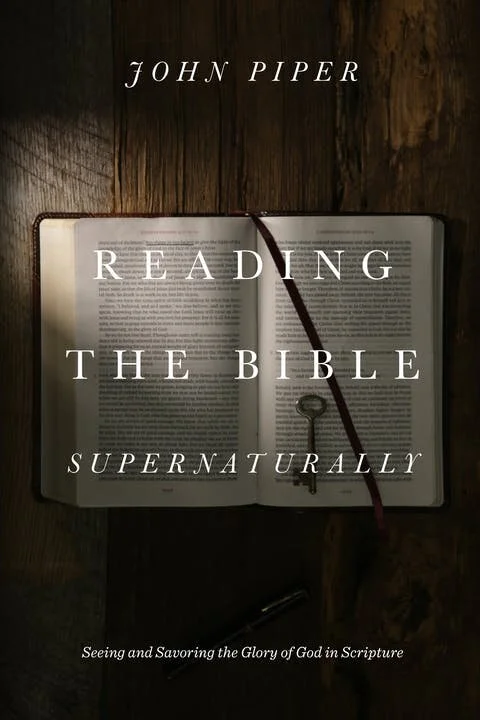
A Review – Reading the Bible Supernaturally by John Piper

reading-the-bible-supernaturally-ow1co3ts.jpg

by Jason Park

Reading the Bible Supernaturally is an in-depth treatment of why we should read the Bible and how we should read it. Piper’s thesis is that “our ultimate goal in reading the Bible is that God’s  infinite worth and beauty would be exalted in the everlasting, white-hot worship of the blood-bought bride of Christ from every people, language, tribe, and nation” (p. 39). From this goal, Piper works backward from discussing the worth and beauty of God as the ultimate aim of all of God’s work and word to our being transformed into the likeness of this beauty when we see it and savor it in the Bible. 

Early on, 2 Cor 3 and 4 appear frequently, a fact which sets a wonderful tone of Christ-centeredness that pervades the whole book. To lock in on seeing and savoring the supreme worth and beauty of Christ when we read the Bible is the only way we can ever be changed into the image of Christ. And this goal of Bible reading is the Spirit’s explicit desire and activity (cf. 2 Cor 3:18).  

This is a lengthy book. But by retaining focus on explaining passages and their implications to Bible reading, Piper does believers a great service. He reminds us that the text will reveal the worth and beauty of Christ and lead us into deeper worship. The first half is deeply theological but not in a dry, academic way. It’s packed with pastoral wisdom and heart-counseling insights that rightly elevate Bible reading to its proper heights. 

In the latter half of the book, Piper details how God works supernaturally through our natural act of reading – that in using our natural gifts and abilities, God enables us to see His glories in the text of Scripture. But in our natural act of reading, we need humility, prayer, and faith. In these chapters, Piper first expounds his now-famous A.P.T.A.T., an acronym for steps on living the Christian life in the power of the Spirit (summarized on pp. 244-249). Then, he unpacks a series of prayers meant specifically to help us in our quiet times – called I.O.U.S. (pp. 251-261). These acronyms orient our hearts to God as receivers, humbling ourselves under His mighty hand so that He might help us grow in grace and see glories in the Bible.   

It’s a dense book, one you can’t read quickly or without a little engagement. But by the end, you will gain a greater awareness of how much deeper our time in the Word could be and a greater appreciation of how much of Christ’s glory there is to mine in our Bibles.  

Resources on Romans

janko-ferlic-sfL_QOnmy00-unsplash.jpg

by Jon Buck

As you know, we’ve been working through the book of Romans as a church family. The book is designed as an unfolding of the Gospel in all its glory. A simple outline of the book is below. 

I. Introduction - 1:1-1:17
II. Sin - 1:18-3:20
III. Justification - 3:21-5:21
IV. Sanctification - 6:1-8:39
V. What about Israel? - 9:1-11:36
VI. Application - 12:1-15:33
VII. Greetings and Conclusion - 16:1-27

The book effectively explains the beauties of the Gospel, and the implications that arise from the application of the Gospel to daily life. 

Helpful Commentaries
There are a TON of resources and commentaries on the book of Romans. Many of them are extremely helpful. The list I’ll present here is by no means exhaustive, and so if your favorite writer isn’t represented, don’t take it personally. 

Martyn Lloyd-Jones on Romans Lloyd Jones’ sermons are preserved in a large set offered by Banner of Truth Trust. The books are incredible, honestly! They are not particularly technical in the original languages, so they are very accessible. 

D. Barnhouse - Romans Donald Grey Barnhouse’s sermons on Romans are also preserved. They are very helpful as well. They come as a two volume set, and provide lots of rich information for an in depth study. They are also very conversational and easy to read. 

John Murray’s Commentary Very helpful analysis. Slightly more technical, but less wordy. Not sermons - just commentary. Easy to read. However, a bit expensive, as commentaries go! 

John MacArthur’s Romans Commentary Published by Moody, this set is very helpful as well. Not super technical, but provides extremely helpful information for study and understanding. The set is available on Kindle as well! 

Tom Schreiner Romans Commentary Lest you think all good commentators are named John, Tom Schreiner has an excellent commentary on the book. More technical in the original languages, this commentary provides lots of background and helpful information. 

What you hold in your hand…

ben-white-LJQEDQAmAnI-unsplash.jpg

by Jason Park

We all know that reading the Bible is essential. But why? What is unique about the Bible that demands we read it? And how should we approach it? 2 Tim 3:16-17 helps us answer these questions by offering two foundational beliefs about the Bible. 

1.     The Bible contains nothing less than the inspired words of the living God.Read through the litany of the perfections of God’s word in Psa 19:7-11. That is what we’re taking up every time we open our Bibles. 

If you don’t believe that the Bible is inspired, you will not long submit to it, because you won’t believe in its authority over your life. You will eventually default to your flesh, picking and choosing which parts to obey and which to not. And, you will minimize certain teachings that don’t agree with your deep-down desires.  

You’ll listen to other authorities – the media or your friends. And those authorities will only confirm what you really want to submit to – your own authority.  

That’s the constant battle: our self-idolatry vs. Christ’s lordship…wanting self-rule vs. humbling ourselves under God’s mighty hand. 

But this is what the Bible attests about itself, what God attests about the Bible: it contains the very words from the mouth of God. Everything hinges on this. 

2.     We need the Bible everyday for everything. The second half of v. 16 says, without Scripture you cannot teach profitably (you’ll be teaching mere human wisdom, opinions, and preferences), you won’t be reproved or corrected (you’ll be pride and blind to your own sins!), and you won’t grow in righteousness (the fruit of the Spirit will be stymied in your life).  

Read through this list: it demands that we get the Bible in us everyday because everything depends on it.  

It’s the food that sustains us (Deut 8:3). Peter says in 1 Pet 2:2 that like babies, we must long for the pure milk of the word (the gospel in that context) so that we can grow in our salvation. No milk, dead baby. No word, functionally dead Christian (not that you lose your salvation, but you’re stunted in your growth). 

So, if you don’t take in the Word regularly, you won’t be equipped – thoroughly geared up – for every good work (2 Tim 3:17), the good works God prepared beforehand so that we might live them out (Eph 2:10). We can’t fight temptation, resist the devil, grow in Christlikeness, and serve others unless we wield the sword of the Spirit, the word of God (Eph 6:17). 

And handling this sword doesn’t take a degree or locking yourself up in a room; it takes faith.  And thankfully, the word of God itself produces faith (Rom 10:17). So, as you read it, it creates and nurtures faith. And faith energizes our efforts to continue in the Word. 

So, let’s take up and read our Bibles, believing that our Father has spoken to us and that it will change our lives.